What should you compare before choosing an app?
Start with three questions: how will you record movements, which device will you use, and which plan covers the tasks you need? Check individual features and conditions rather than assuming that all free apps share a funding model. Importing a file, exporting records and preparing a budget are separate tasks.
Try a small period you can check against your source records. Desktop availability does not establish that every mobile function exists on the web, and a downloadable report may not contain everything needed to rebuild your records elsewhere.
How do these seven apps differ?
The table summarises desktop access and published costs, followed by the details and official sources for each app. Prices marked USD are not converted into another currency. Store, tax and platform conditions can differ. Use the comparison to identify what to check before starting a trial or paying for a plan.
| App | Desktop access | Published cost |
|---|---|---|
| Sumant | Web on mobile and desktop | Free; PRO Founder €19.99, single payment. |
| YNAB | Web and mobile apps | $109/year or $14.99/month USD; applicable taxes additional. |
| Fintonic | The cited sources do not establish an equivalent expense dashboard on the web. | App described as free; financing has separate conditions. |
| Monefy | Official downloads advertise iOS and Android. | Free basic version and optional upgrade; check your store. |
| Spendee | Web available; budgets listed for mobile. | Basic free; Plus $14.99/year, Premium $35.99/year USD. |
| Wallet | Web and mobile, with platform differences. | Free and Premium options; consult the price in the app. |
| Money Lover | Desktop web can show and add transactions. | Lifetime Premium $19.99 USD on the US App Store; Linked Wallet separate. |
1. Sumant
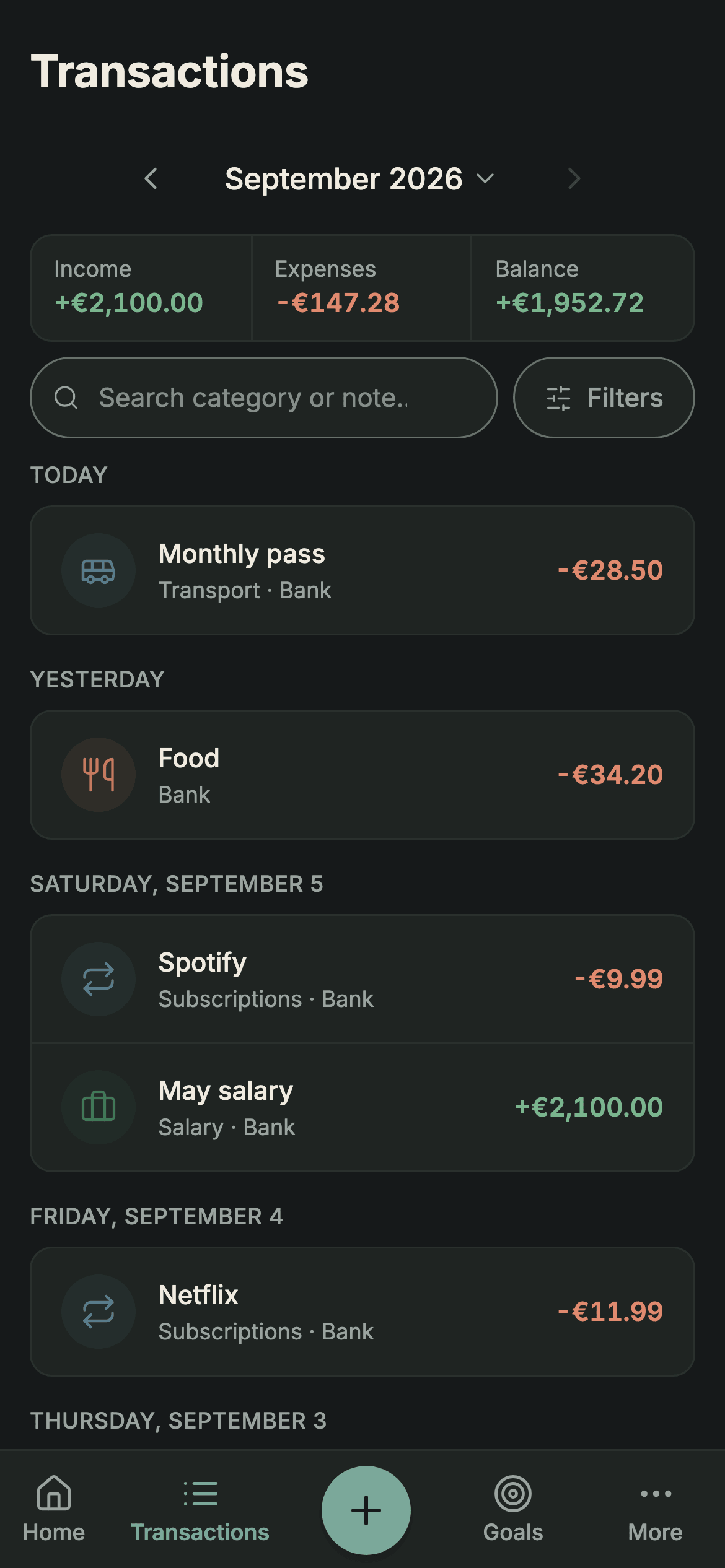
Sumant is our app. You can record movements manually or review a CSV/XLSX file before importing it. It runs in a browser on mobile and desktop, with an email and password account required. The free plan includes one import of up to 250 selected transactions. PRO Founder costs €19.99 as a single payment.
Transactions do not arrive through an automatic bank connection. JSON export is available for free; CSV/XLSX export requires PRO. With PRO you can create categorisation rules and recurring transactions. Shared accounts are not part of the current product.
Sources: Sumant plans · checked on .
2. YNAB
YNAB combines transaction recording with a budgeting method that assigns available money to categories. Its published price is $109 a year or $14.99 a month, plus applicable taxes. The 34-day trial described on its pricing page applies to direct sign-up with YNAB.
It offers web and mobile access. Check bank-import availability for your particular accounts if that function matters; you can also add an unlinked account and record movements manually. The presence of a country on a support list does not establish that every bank account there is supported.
Sources: YNAB pricing and features · checked on ; Adding an account in YNAB · checked on .
3. Fintonic
Fintonic describes an app that brings together information from connected accounts and categorises movements. Its current website also presents financing services and FinScore. In its explanation of free access, the company states that it receives commissions for intermediating in products such as loans and insurance.
The app being described as free does not mean that a loan has no interest or other conditions. Distinguish the task of reviewing spending from a possible financing application, and read the terms of the particular service you are considering.
Sources: Fintonic: free access and commissions (Spanish) · checked on ; Current Fintonic services (Spanish) · checked on .
4. Monefy
Monefy focuses on recording transactions and reviewing categories. Its website describes a free basic version and an optional upgrade. Check the features and price offered in your own store instead of assuming that a price from another platform or promotion applies to you.
The official download page advertises iOS and Android apps and does not advertise a web client. That matters if you specifically need a browser interface on your computer; it does not establish that its mobile apps cannot run on any compatible computer.
Sources: Monefy features and plans · checked on ; Official Monefy downloads · checked on .
5. Spendee
Spendee Basic includes one cash wallet and one budget. Plus is listed at $14.99 a year and Premium at $35.99 a year, with bank connections in Premium. These are USD prices; the pricing page notes country differences. Budgets are listed for iOS and Android, with web support still pending.
For exports, its help documents CSV or XLS from the mobile apps, not from the web version. XLS and XLSX are different formats. If you want to bring these movements into Sumant, choose CSV and review the columns before confirming the import.
Sources: Spendee plans and platforms · checked on ; Exporting Spendee transactions · checked on .
6. Wallet by BudgetBakers
Wallet offers transaction recording and budgets with mobile and web access. Its help places bank connections in Premium and lists monthly, annual and lifetime purchase options. For current prices it directs users to the app; a single store purchase does not establish a universal price.
Functions differ between Android, iOS and the web. Check the platform you intend to use for any feature that is essential to you. An available report or export should also be checked for what it actually contains before you plan a move to another service.
Sources: Wallet recording and budgets · checked on ; Wallet Premium plans and platform differences · checked on ; Wallet bank connections in Premium · checked on .
Compare Sumant and Wallet by BudgetBakers
7. Money Lover
Money Lover offers transaction recording and budgets. The US App Store listing shows lifetime Premium at $19.99 USD and distinguishes Linked Wallet as a separate service. That is the price and purchase type in that store, not a universal subscription including bank connections.
Official help confirms that its desktop web version can again display and add transactions. It says the web version is not available in mobile browsers, but that announcement does not establish a Premium requirement. Check the current conditions for the task you need.
Sources: Money Lover on the US App Store · checked on ; Money Lover: return of the web version · checked on .
Compare Sumant and Money Lover
Which option fits the task you want to complete?
For manual recording, compare the entry form and review process on your usual device. For budget allocation, check how you assign available money. If bank imports matter, confirm support for your specific accounts. Include the cost of the features you actually need, together with the conditions for recovering your records.
Keep your original records while you try a small sample. Check dates, categories and totals before adding more history. If a task remains unclear, consult that product’s current documentation; the published features in this list are not a substitute for testing your own workflow.